Pages

Showing posts with label fantasy art. Show all posts

Monday, 28 February 2022

Nature, Animal and Folklore Art

Welcome back to my art blog! It’s been longer than I can remember since I last wrote a post, but I’m hoping to be back into the swing of things now with more regular posts about my art inspired by nature, animals and folklore.
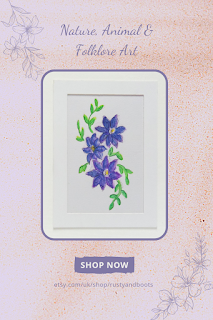

A watercolour illustration of blue clematis flowers in a pin for Pinterest saying nature, animal and folklore art, shop at etsy.com/uk/shop/rustyandboots


For anyone who doesn’t know me, I’m Sarah, I live in Wales and I’m an artist with an Etsy shop, selling watercolour illustrations and acrylic art. I love nature, animals, particularly cats, foxes, owls and hares and I love mythology, folklore and fantasy. 

Something that really interests me is the mythology and folklore of nature and animals and I have a huge interest in Celtic mythology such as The Mabinogion and the Irish Mythological Cycles.

I feel deeply connected to nature and believe that we are part of nature, not separated from it. Nature has been shown to have a beneficial effect on mental health and wellbeing. Being immersed in the greenery of forests or fields lifts the spirits and lowers stress levels as it activates the parasympathetic nervous system. The human eye can distinguish more shades of green than any other colour due to the make-up of the rods and cones in our eyes. It is thought that this may be an effect of having lived within nature – in forests for example – thousands of years ago. 

A watercolour painting of a spotted wood butterfly on a green and purple patterned background.


I also feel connected to animals, sometimes feeling more at home and at ease with them than humans. We receive companionship and love from them in an accepting, non-judgemental way. If you respect and love animals, they respect and love you whoever you are. Wild animals are such a beautiful part of our landscapes and to share space with one of them can be a magical moment. 

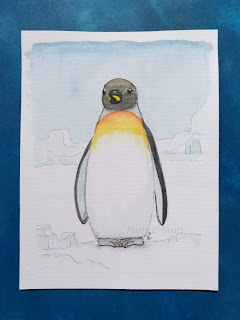
A watercolour illustration of an Emporer penguin in the Antarctic.


Folklore connects us to our ancestors, the old beliefs and wonderful stories of mysterious and magical happenings. It’s a more enchanted way of looking at the world and reminds us that there is beauty and wonder out there if we choose to look for it: the perfection of the petals of a flower, the tides of the oceans, the communication between trees in a forest through the webs of fungi underground, the grace of a deer bounding away… 

A blue dragon breathing fire on a castle battlement. Acrylic fantasy art.


This is my aim with what I do: to create art that inspires love for these things and represents these themes for those who already love nature, animals or folklore. Unique artworks that will never be repeated exactly to provide something pretty to look at that will lift your mood and reconnect you with magic and enchantment. 


Shop: Rusty and Boots

Instagram: @rusty_and_boots

Twitter: @RustyandBoots

Facebook: RustyandBoots

Pinterest: Rusty and Boots


Thursday, 24 February 2022

Folklore in Art

Mythology and folklore are subjects that really interest me and influence my art. It’s sometimes a topic that some people dismiss as being “just” stories for children but I think those people are missing the point. Mythology connects us with our ancestors and has themes that still resonate with us today. We may have technology and science but human life is much the same. We can still identify with the things that the characters in myth go through, share their experience. We can learn from stories and they offer a respite from modern life, taking us to another place. 

A fantasy artwork with a brown mushroom in the foreground and trees and mountains in the background.


Folklore is full of wisdom that has been passed down through the generations. Stories are peppered with symbols and metaphors that help us understand life. Images of mythology can remind us of these themes, things that may be close to our hearts, reminding you about what’s important in life.

 “Whether or not they contain the encapsulated wisdom of ages past, what is certain is that myths, fairy tales and folklore offer us a world imbued with participation mystique – a world in which humans are fully enmeshed. In this world, animals always have something to teach us, trees and plants can save or cure us, wise old men and women are waiting in the dark woods to help us, and a well may be a doorway to another world. Myths and folklore can put us back in touch with the seasons and turnings of the year, and they can restore our acceptance of the necessary cycles of life. They can also remind us that we have a responsibility to future generations, and to the planet as a whole.” 

The Enchanted Life by Sharon Blackie.

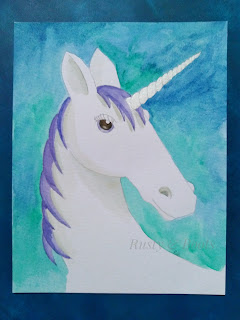
A watercolour artwork of a white unicorn with a silver horn and purple mane on a blue and green background.

They can also set our imaginations going, making us wonder what’s happening in the picture? What land are they in? Where does that path go? Stories are universal, yet personal too. I’ve heard stories about my grandparents from my mother and father, information that gets passed down through the family. In that way, we are all stories.

A watercolour painting of the Green Man with oak leaves on a white mountboard in a frame surrounded by flowers.


Stories and images can also help us remember the enchantment that can be found in life. In the midst of the difficulties we go through, we can find moments of magic and wonder. The gleam of sunlight on a raindrop on a leaf, for example (and if you’ve seen my social media posts, you’ll know I LOVE those!). A ring of mushrooms growing in the wood - maybe there are faeries about! A face in the bark of a tree. Holes in the ground – what kind of creature might live in it? 

I love seeing the magical side of life. Whatever terrible things are going on in the world, created by humans, the natural world is a beautiful place, full of mystery and marvels. Both stories and nature help us to maintain curiosity about the world we live in as well. Where did the inspiration come from? Who originally told the story? Where did it happen? 

“It is by such statements as, ‘Once upon a time there was a dragon,’ or ‘In a hole in the ground there lived a hobbit’ – it is by such beautiful non-facts that we fantastic human beings may arrive, in our peculiar fashion, at the truth.” 

Ursula K. Le Guin, Why Are Americans Afraid of Dragons? 

An acrylic painting of the Mari Lwyd, a horse skull with a white sheet over the top with red and green ribbons on a blue grey background.


Do you love myth, folklore or fantasy books? What is your favourite? How do they make you feel? Let me know in the comments or on social media (links below). 


Shop: Rusty & Boots Art

Instagram: @rusty_and_boots

Twitter: @RustyandBoots

Facebook: RustyandBoots

Pinterest: RustyandBoots

Wednesday, 8 April 2020

Mythical Creatures: Each-Uosge


The Each-Uisge (pronounced ech-ooshka) is a Scottish water horse from the Highlands of Scotland. It is similar to the kelpie, but much fiercer and lives in the sea, sea lochs or fresh water lochs, whereas kelpies live in rivers or streams. It can shapeshift to turn into a horse, a pony, a handsome man or an enormous bird and will drag unsuspecting victims down into the depths of the sea. 

The creature will eat sheep and cows but likes to attack humans on land, or will allow itself to be ridden. Having touched the horse, the victim will become stuck, unable to free himself and the horse will dash into the loch, drowning the rider so the horse can eat him. People who lived in the Highlands were wary of lone animals or people at the side of lochs and kept away, for fear that they might be the each-uisge. 

In the shape of a human man, the each-uisge can be recognised by the weeds and mud in his hair. He will attempt to seduce women, probably to eat them, but there are tales of women escaping, either through their own efforts or the intervention of their father and/or brother.


There is also a version of the each-uisge in Ireland, the Isle of Man and Wales. The one on the Isle of Man is like the each-uisge in that it will eat humans, but the Irish and Welsh versions can be tamed and ridden like an ordinary horse. In the Isle of Man, it is called the cabyll-ushtey, in Ireland it is named the each-uisce and in Wales, it is the ceffyl dwr. I know a bit more about this Welsh version, having read more folklore about it.

It is much the same as the others, but will tempt a traveller to ride, then gallop away, throwing the traveller to his death. The horse can be dappled, grey or the colour of sand. There is a tale of one particular ceffyl dwr at St Bride’s Bay in Pembrokeshire. After a storm, a horse appeared in the bay and was captured by a farmer who used the horse to pull the plough in his fields. However, one day, the horse, with no warning, whisked the ploughman and the plough into the waves, dragging them to the deeps. We are not told whether the man survived. 


In my paintings here, I tried to captured the essence of the sea in the horse and to show that the each-uisce is of the sea, a sea spirit, if you like. I couldn’t decide which version to do, a close up or a horse in the seascape, so I did both. 

As always, you can find me here:

Instagram: @rusty_and_boots

Twitter: @RustyandBoots

PinterestRustyandBoots

Facebook (art): @RustyandBoots

Facebook (writing): @talesfromdemetia


Research:
Myths and Legends of Wales retold by Tony Roberts
mysteriousbritain.co.uk
Wikipedia

Monday, 23 March 2020

Mythical Creatures: Dryad


The next mythical creature on the list is the dryad. They are tree spirits from Greek mythology and are the daughters of Zeus, the most powerful of the gods. They live in forests or woods and protect it by frightening humans who wish to do it harm. Usually, though, dryads are peaceful beings. They are not immortal, but live for many years and usually take the form of young, beautiful women moving among the trees.

Hamadryads, on the other hand, are beings within individual trees, each spirit having her own tree, unable to move and living as long as the tree does.

This is the sort of spirit that the Celts and many other cultures around the world believed in. Spirits were everywhere in the landscape. Each tree, each stone, each river had its own spirit. I love this idea and so I painted an image of a tree with its spirit inside it, something you might miss unless you look really closely when you pass by….


 Back in the time of the Celts - the Bronze Age and Iron Age - and among cultures such as the Native Americans, the landscape was sacred and commanded respect. If a tree was cut down for its wood to be used, an offering was given back to make up for what was taken. They only took what was needed.

I wonder if we had kept that belief whether we might have continued with that respect for the natural world and treated it and its animals better.

The idea that each tree has a spirit is actually not that far away from the truth, because its been shown that trees are full of life; the trunk pulling up the water and food from the ground, the leaves doing their thing with photosynthesis, lichen and moss on the bark, insects living in and on the bark and – this is what I really love – trees can actually communicate with each other. If one is being attacked, it can send out a chemical to warn the other trees around it. They can’t move to escape, obviously, but those trees can then produce another chemical to make their leaves less tasty to whatever is eating them.

As well as that, trees have a symbiotic relationship with fungus in the ground. They share nutrients and the trees communicate through the fungus too. How they do it is not really within the scope of this blog, I’m here for art, myth and stories, but there are plenty of books or websites that you can find information in. If you’re interested, do go and find out. Nature is wonderful. 

You can find me here;

Shop: Etsy: Rusty and Boots
          Folksy: Rusty and Boots

Instagram: @rusty_and_boots

Twitter: @RustyandBoots

Facebook (art): @RustyandBoots

Facebook (writing): @talesfromdemetia

Pinterest: RustyandBoots

Monday, 16 March 2020

Mythical Creatures: Cat Sidhe


The third Mythical Creature in our alphabetical list from Animal Alphabets is Cat Sidhe. twitter.com/AnimalAlphabets

The Cat Sidhe is an Irish or Scottish creature which is all black except for a white spot on its chest. Names for it vary; as well as Cat Sidhe, there is also Cait Sidhe and Cath Sith. It is a large fairy cat which will try to steal the souls of the dead before they are buried, but in my painting, he seems like he’d look really cute while doing it!


Just as a side note, in case you’re wondering, the Sidhe are Irish fairies, which are divided into the Seelies and the Unseelies.

The cat is meant to haunt the Scottish Highlands and there are many legends about it in Scotland and some in Ireland. He will try to steal the souls of the dead before they are claimed by the gods by walking over the corpse. To prevent this, people held wakes to keep the cat away and used games to distract the cat, such as riddles and wrestling. The riddles were always left unanswered for the cat to ponder, therefore taking his mind off the dead body. They also spread catnip in other rooms to take the cat’s attention and played music, as the cat loved to dance. They also never lit fires in the room where the corpse was as the cat was attracted to the warmth.

The cat may also be a witch who can shape-shift, but she can only become a cat nine times. If she transformed into a cat for the ninth time, she would stay a cat permanently. This is thought to be where the idea of cats having nine lives originated from.

It was believed that on Samhain (Halloween) the cat sidhe would bless the house of those who left a saucer of milk out for him to drink. Those who didn’t would be cursed, their cows failing to produce milk.

There are tales of the cat transforming into human shape, but retaining his cat legs and his tail and feline features. They are also told to be able to perform basic magic.


There are other cats in mythology which you may find interesting too:

In France there are fairies called White Ladies. They wait near bridges after dark and ask a lone man walking past to dance. If he refuses, the White Lady throws him over the bridge or sets her pet owls and cats on him.

Witches had familiars, of course, which were most often cats.

Vampires, as well as being able to turn into bats, dogs and wolves, could also become cats.

In Japan, there was a two-tailed vampire cat who didn’t bite her victims, but strangled them.

Finally, there is a creature called the barguest, which haunts lanes and churchyards at night. It is usually a huge dog, but can become a cat or a goblin.


I hope, if you are interested in this, that my brief summary of mythical beings leads you on to find out more. If you do, beware! It can lead you down a mythical rabbit hole. I’ve been there! So much to read about.

As always, you can find me here:

Instagram: @rusty_and_boots

Twitter: @RustyandBoots

Facebook (art): @RustyandBoots

Facebook (writing): @talesfromdemetia

Pinterest: RustyandBoots


Information from:

Wikipedia

Fantasy Encyclopedia, A Guide to Fabulous Beasts and Magical Beings by Judy Allen


Monday, 9 March 2020

Mythical Creatures: Brownie


The next mythical creature set for the Animal Alphabets challenge was Brownie. I’d heard of these beings, but didn’t know a lot about them, as they’re Scottish. I’m more familiar with the Welsh bwbach, so I started with finding out what they look like. 


They’re creatures who live in houses but prefer farms as they like being with the animals. They help with jobs that need to be done, like tidying, washing, or mending at night when the people are asleep, so they’re never actually seen. Payment for their work is a bowl of milk or cream and some bread left out for them, but they are insulted if it is given to them directly. If you’re critical of them, or annoy them, they’ll play tricks on you. 


They are dressed in ragged clothes, which is often a brown hood and cloak or white robes and if given new clothes, they vanish forever, either because they see it as the ultimate insult, or because they take it as a full payment for all their work, (a probable influence for Dobby in Harry Potter). They are variously brownish, covered in hair or have curly brown hair and can be either human sized, very big or small. In fact, the original idea of the brownie was thought to be very big and a spirit of the house, looking after all inside.


An angry brownie can turn into a boggart, a creature which loves to scare people, causing problems in the house, making noises, throwing things around (a bit like a poltergeist) or following you in the dark. They are covered in black hair. 


So, taking all this into account, I went for the happy version of the brownie and painted this:


There are versions of the brownie all over the world, it seems; the gobelin, the bog and the baga are just a few. There’s also the English hobgoblin and the bwbach in Wales. The bwbach was good-natured and worked with the maid in the kitchen, where he was thought to live in the fireplace. The maid would make the fire, sweep up, set the bowl of milk and the bread ready for the bwbach at the end of the day, then leave the cream filled churn nearby and go to bed. In the morning, she would wake to find the milk and bread gone and the churn worked so that the butter was ready. The bwbach was not fond of people who did not drink and would, if he took against someone, cause mischief in the house, making dogs howl, or frightening the maid. He could also carry people off into the air, transporting them somewhere else.  


All these versions of the brownie or bwbach are probably descended from the belief of ancient people that every house had its own spirit, as I mentioned above, looking after the house and the family, either a spirit of the home or an ancestral spirit. For example, its possible that the ancient Celts set some food aside for the spirit in return, or as recognition, for its protection. If displeased, the spirit would probably have shown its anger. For the ancient people it was just a fact of life that spirits were everywhere and although they’ve been very much diminished in modern times, I’m really glad that we still have these beings in folklore.


You can find me here:

Instagram: @rusty_and_boots

Twitter: @RustyandBoots

Facebook (art): @RustyandBoots

Facebook (writing): @talesfromdemetia

Pinterest: RustyandBoots


Books referenced:

British Goblins:Welsh Folklore, Fairy Mythology, Legends and Traditions by Wirt Sikes

Fantasy Encyclopedia A Guide to Fabulous Beasts and Magical Beings by Judy Allen

Exploring the World of the Druids by Miranda J. Green

Monday, 2 March 2020

Mythical Creatures: Afanc


You may have seen on Twitter and Instagram that there’s an art challenge every Monday called Animal Alphabets. It’s a challenge going through the alphabet with different themes and a creature beginning with each letter. If you’d like to take a look at the type of thing I mean, you can find it here: AnimalAlphabets The last round, which was the first one I joined in, was all on birds. The current round has the theme of Mythical Creatures and, as I love mythology, I thought I’d post here about each creature. 


The first one was A for Afanc, which I was really excited about because the Afanc is a Welsh creature. There is variation in the name, though. In the tale Peredur, Son of Efrawg, which is one of The Three Romances usually included with The Mabinogion, it is called an Addanc.

I knew what it was as I’ve read a lot of Welsh myth and folklore, but none of the tales tell you what it looks like. I’d been wondering about an Afanc’s appearance for a long time, since I first read The Mabinogion, but never really come up with a solution. The general description of this creature is that it looks like a beaver, a crocodile or a dwarf and is very fierce. You wouldn’t want to meet one! But they can be tamed by maidens. The thought of coming up with a picture of an Afanc put dread into me, but suddenly I had a vision of what it could look like: a sort of beaver/crocodile cross in brown and green looking very angry. Here is my painting:


In folklore, there are quite a few stories of the Afanc. They live in rivers or lakes and cause inundations when angry. All tales are more or less the same, with some variation. One tells of Hu Gadarn who pulled an Afanc out of Llyn Llion (a lake) using two oxen to drag the creature out in order to prevent an inundation.

Another tells of one in Llyn yr Afanc (Lake of the Afanc) in the River Conwy. A maiden lured the Afanc out of the water and while he slept on her lap, men bound him in chains. When he woke, he was furious (quite understandably I think), threw the men off and headed back into the lake. They sent for two oxen, attached the chain to them, and dragged the Afanc out, taking him to Llyn Cwm Ffynnon Las (Lake of the Blue Well Valley) where they left him. They obviously weren’t too bothered about that lake flooding!

There is even a tale of King Arthur pulling an Afanc out of Llyn Barfog with his warhorse.

In the tale of Peredur, who was one of King Arthur’s men, Peredur went on a long journey during which, he came to the court of the Sons of the King of Suffering. He saw three horses carrying a man each in their saddles, all dead. A woman took them off the horses and bathed them in turn in a tub of warm water, applying ointment to their bodies and all three men came back to life. Peredur asked one of the men why this happened and the man replied that every day, they were killed by an Addanc in a cave and came back to be revived to go through the same thing again and again.

The following morning, Peredur asked to go with the men to the cave, but they wouldn’t allow it, saying that if he was killed, there would be no one to bring him back to life. However, Peredur followed them. On the way, he came across a woman sitting on a mound.

‘I know where you are going,’ she said. ‘You go to the cave to fight the Addanc and he will kill you, not with his strength, but with his guile. There is a stone pillar in the entrance of the cave and he hides behind it so that he can see everyone who enters the cave, but they can’t see him. He kills everyone with his poisoned spear. If you promise to love me, I will give you a stone so that you can see him, but he won’t see you.’

Peredur said he did love the woman, she placed the stone in his hand and disappeared. Carrying on his way, Peredur came to the cave, took the stone in his left hand, making him invisible, and his spear in his right hand. Entering the cave, he saw the Addanc, killed him with his spear and cut his head off. As he left, he was met by the three men, who told him that there was a prophecy about him, saying he would kill the monster. They offered him any of their sisters for a wife and half their kingdom, but Peredur refused the offer and carried on his journey.

So, there is a brief summary of the tales of Afancs. I’m hoping to give you a brief overview of other mythical creatures as we go along. I’m also going to tell you more stories from The Mabinogion and the characters within it. I hope you’ll join me and enjoy what I have to tell.

You can find me here:

Instagram: @rusty_and_boots

Twitter: @RustyandBoots

Facebook (art): @RustyandBoots

Facebook (writing): @talesfromdemetia

Pinterest: RustyandBoots


Folklore from Myths & Legends of Wales retold by Tony Roberts

Tale from Peredur, Son of Efrawg from The Mabinogion translated by Gwyn Jones and Thomas Jones


Thursday, 7 February 2019

Much Room for Mushrooms?


If you’ve seen my social media posts, you might know where I’m going with this. Last year I had a bit of a mushroom phase, which I like to think was like Picasso’s pink and blue periods. That’s what I like to tell myself, anyway!  :D  My mother asked me one day if I’d seen this particular group of mushrooms growing nearby, so I went to look and took my camera with me. This is what resulted: lots of photos of cute fungi.


 While I’m on the subject, did you know that mushrooms are only the ‘flowering’ part of the fungi? Most of it is underground in vast strings of interconnected webs and are mainly found around trees, especially in a forest. As you can see, these were surrounding a tree stump. Fungi is useful to the trees because it connects them to each other and helps them to communicate.

I know that might sound hippyish, but it’s been scientifically proven that trees communicate with each other. If one is being cut or eaten, it releases chemicals which other trees pick up and they react to it by producing another chemical to make their leaves taste worse. At least that’s what I remember from watching a programme on it! They communicate in a similar way through the fungi, so it’s like a symbiotic relationship.

Nature continues to amaze me and the more I learn, the more I think our ancestors were right that there are spirits in the landscape; i.e., more going on than we think.

Anyway, I was inspired by these photos to draw this, a sort of whimsical, fantasy art picture where the mushrooms in the middle are feeling a bit hemmed in.


That turned into a painting:


It is now mounted and available in my shop.


I love fantasy art, especially that of Alan Lee, Anne Stokes and Lisa Parker. I’ve been thinking about trying some myself, particularly after joining in with the Drawlloween challenge last year hosted by Mab Graves on Instagram. I really enjoyed it and surprised myself with what turned up on the paper. I’ve also begun to like whimsical art, so I think I’ll be doing more of this, trying to stretch myself into new areas. Here are a few of the artworks from the Drawlloween challenge, as I didn’t post on my blog during that time. Some of them need more work and improvements and I may do better versions. Let me know what you think.